Sacrifice
Sacrifice as the strongest form of worship, the liturgy of Yom Kippur, and how Jesus Christ made the last Yom Kippur, which we access at every Mass.
Awaiting review A priest has not yet reviewed this article. Read it alongside the Catechism paragraphs it cites, and take questions to your parish.
- There are many ways people worship
- But the most effective and efficient way is sacrifice: handing full power to a higher being. Examples from several customs and religions:
| Custom / religion | What is given up | Act of sacrifice |
|---|---|---|
| Witchcraft (perdukunan) | An ayam cemani (black chicken) | Slaughter |
| Ethnic traditions (Chinese, Javanese, etc.) | Incense | Burning |
| Judaism, Islam | Goats, sheep, cattle | Slaughter |
| Aztec paganism | A living person | Tearing out the heart |
- The act of sacrifice itself hands power to the one we direct it to
- The more significant the thing sacrificed, the stronger the message of worship we give. For example, a sacrifice of incense is weaker than a sacrifice of an animal (because it is alive), let alone a human being.
The pattern of sacrifice in the Bible
- In the Bible, the people of Israel kept many feasts that involved sacrifice: Passover, Pentecost, Tabernacles, the Jubilee, the feast of Trumpets, Yom Kippur, etc.
- Each feast had its own order of worship, such as the reading of Scripture, a set number of sacrifices, etc.
- Of all the feasts, the one at the centre of Israel’s life (including the Jewish people today) is Yom Kippur
Yom Kippur (the Day of Atonement)
- Yom Kippur is the holiest day of all Israel’s feasts.
- The people of Israel, as well as the rabbinic Judaism that exists today (not the same thing), keep this day every year.
- Yom Kippur took place at the Temple.
- For context, the Temple had 3 parts: the Court, the Holy Place, and the Most Holy Place (holy of holies)
The liturgy of Yom Kippur (Leviticus 16, Leviticus 23:26-32, Numbers 29:7-11)
| Stage | Action | Purpose |
|---|---|---|
| Preparation | The high priest washes himself and puts on a plain white robe | A symbol of purity |
| First sacrifice | A bull is sacrificed by the high priest in the Court, and its blood is collected and sprinkled in the Holy Place | The bull atones for the sins of the high priest and his household, so that he is worthy to enter the Temple and lead the worship. |
| The goat’s sacrifice | The chosen goat is sacrificed in the Court, and its blood collected. | A sacrifice to sanctify the Temple and the people of Israel |
| The Most Holy Place | The priest burns incense inside the Most Holy Place, and sprinkles it 7 times. | Reconciliation of God with sinful Israel |
| Sending out the goat | The priest lays his hands on the goat, confesses his own sins and Israel’s, and sends it into the wilderness | A symbol that the sins are carried out of the holy place |
| Last sacrifice | The priest sprinkles the Holy Place with the remaining blood, changes his clothes, washes himself, and offers the sacrifices in the number commanded | The completion of the liturgy of the day. |
| Sabbath | Israel fasts and rests | The sanctification of the day |
The new Yom Kippur
- God’s plan is greater: the salvation of all humanity
- John 3:16 → For God so loved the world...
- Hebrews 10:4 → For it is impossible that the blood of bulls and goats should take away sins.
- Malachi 1:11 → “For from the rising of the sun to its setting my name is great among the nations, and in every place incense is offered to my name, and a pure (perfect) offering; for my name is great among the nations, says the LORD of hosts.”
Jesus Christ makes the last Yom Kippur
| Yom Kippur | Jesus Christ |
|---|---|
| The high priest sanctifies and humbles himself: he washes himself, and puts on a plain white robe; he offers a bull as a sacrifice for himself | Jesus (the high priest), already holy, humbles himself: he becomes man, is humiliated and mocked, is dressed in a purple robe, is stripped |
| The priest sacrifices the goat in the Court of the Temple | Jesus carries the cross and is crucified outside the city of Jerusalem |
| The priest brings the blood of the sacrifice into the Most Holy Place, to atone for the sins of Israel | Jesus brings his blood to God the Father to atone for the sins of humanity: symbolically at his death, really at his resurrection |
| The Temple veil is torn, a sign that God is no longer separated from humanity | |
| The sacrifice is made every year | One sacrifice for ever, accessed again through all time, every day, in the sacrament of the Eucharist. |
From the crucifixion of Jesus, besides the 3 themes of Revelation and God’s covenant, we can see the pattern of sacrifice in the Mass from the feast of Yom Kippur.
Sacrifice in the Mass
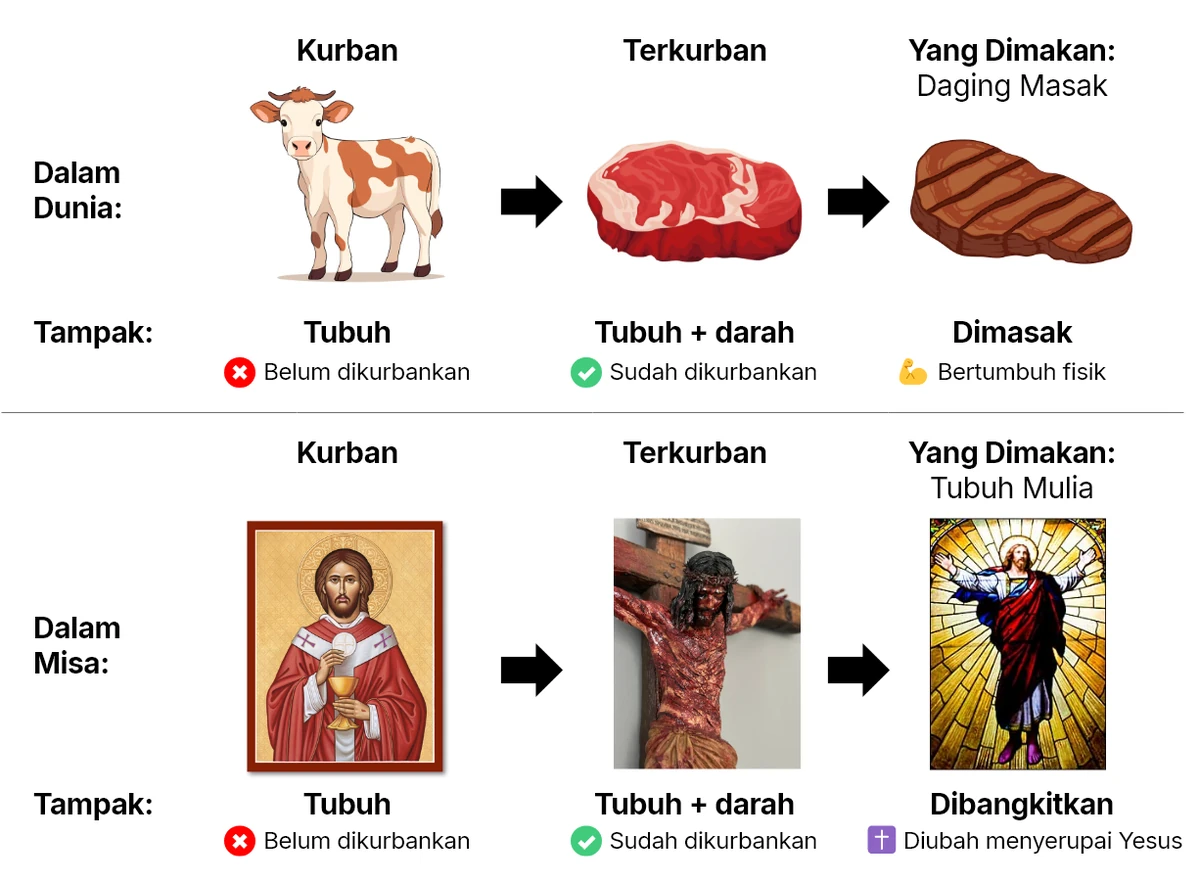
The Mass: who offers the sacrifice
- Jesus Christ is the principal offerer and the High Priest;
- The priest at Mass acts in the person of Christ.
The Mass: the sacrifice
- It is, of course, Jesus Christ himself in the year 33
The Mass: the act of sacrifice
- The priest makes a mystical separation when he says the words of consecration, before the Host and the chalice are raised.
- Mystical separation → “empirical” / grounded in evidence
An important note
- The Mass does not sacrifice Jesus again. In every Mass, past, present and future, we access again the one sacrifice: Jesus Christ in AD 33 on Golgotha
- The sacrifice of the Mass and the sacrifice of the cross are the same, but differ in form: the cross is bloody, while the Mass is unbloody, under the appearances of bread and wine.
Worship in the Mass
- Adoration — acknowledging the perfection of God.
- Thanksgiving (gratitude) — answering God’s gifts, earthly gifts, but above all spiritual ones (because he humbled himself to save us all).
- Petition (impetration) — asking for grace, mercy, or a particular intention through the Mass.
- Atonement (propitiation) — reconciling God to man, or making God well pleased with him; applying the merits of Christ and asking God to grant repentance, grace and mercy.
The Mass: perfect worship
- Adoration, thanksgiving, petition and atonement at Mass are perfect, because Jesus Christ himself, crucified in the year 33, is present among us and perfects all our efforts.
- Speak to God as his bride: with respect, without fear, honestly, hiding nothing.